How To Optimizing C-UAS Sensor Deployment in Smart Cities
2026-02-27

The United States is the largest and most fragmented counter-drone market in the world. MarketsandMarkets puts US counter-UAS systems at $2.49 billion in 2025, rising to $8.60 billion by 2030 at a 28.1% compound annual growth rate — faster than the 25.1% global average (MarketsandMarkets, August 2026). The demand is not theoretical: the FAA says it receives more than 100 UAS sighting reports near airports every month (FAA).
What makes the US supply base different is consolidation. AeroVironment absorbed BlueHalo, and with it the SkyView RF line and the LOCUST laser. Ondas Sentinel now owns DZYNE Technologies and the Liteye/High Point Aerotechnologies portfolio alongside Iron Drone. CACI bought Ascent Vision Technologies, and Axon bought Dedrone. The result is a market where a handful of primes control the programme-of-record work while dozens of small firms own a single sensor, effector or software layer. The list below separates the two.
Companies are ranked by how directly the core product serves a counter-drone mission, then by technology differentiation, government track record and the depth of the supply chain behind it. Primes that field both sensors and effectors at programme scale sit at the top; single-technology specialists follow in order of how much of the kill chain they close; component suppliers and early-stage entrants sit at the bottom. Size appears on every card but is not the ranking criterion — a ten-person team with a working interceptor outranks a conglomerate selling services. If the sensor categories are unfamiliar, our primer on the main types of drone detectors explains the radar, RF, electro-optical and acoustic layers that recur below.
Ranked by how directly each company’s product serves a counter-drone mission, these are the US counter-drone companies that matter most in 2026. The list covers primes, sensor houses, effector makers and the software layer that ties them together. Companies whose business is consulting, guard services, training or industry association work were deliberately excluded, as were firms with no verifiable public web presence.
Note: Company profiles are based on publicly available data from each company’s website and LinkedIn profile. Acquisition notes reflect the corporate structure visible on company sites at the time of writing.
RTX is the anchor of the US counter-drone industrial base: the supplier that fields both the radar and the interceptor inside the Army’s low, slow, small unmanned aircraft integrated defeat system. For allied buyers, Coyote plus KuRFS is the benchmark against which every other US system is priced and compared, and it ranks first because it closes the entire kill chain rather than one layer of it.
01
RTX (Raytheon)
TIER 1 · PRIME & PROGRAM OF RECORD
Coyote interceptors and KuRFS radar behind the US Army’s LIDS
| 🏭 Industry | Aerospace and Defense |
|---|---|
| 📍 Location | Arlington, Virginia |
| 👥 Size | 10K+ employees |
| 🌐 Website | rtx.com |
RTX is the Arlington, Virginia-based parent of Raytheon, Collins Aerospace and Pratt & Whitney. Its counter-UAS line pairs KuRFS radars with the Coyote family of interceptors — a kinetic Block 2 variant and a non-kinetic Block 3 — and is fielded by the US Army as part of its low, slow, small unmanned aircraft integrated defeat system.
AV is the most complete US counter-drone portfolio after RTX: RF detection from SkyView, kinetic intercept through Titan, and directed energy through LOCUST under one roof. It ranks second because that breadth is recent and still being integrated, but no other US company can offer a buyer detection, kinetic defeat and a laser from a single contract.

02
AeroVironment (AV)
TIER 1 · PRIME & FULL-STACK C-UAS
Titan C-UAS, LOCUST laser and the BlueHalo SkyView RF line
| 🏭 Industry | Aerospace and Defense |
|---|---|
| 📍 Location | Arlington, Virginia |
| 👥 Size | 1K-5K employees |
| 🌐 Website | avinc.com |
AeroVironment designs and builds unmanned systems, loitering munitions and counter-UAS equipment. Its 2025 acquisition of BlueHalo brought the SkyView RF detection line, the LOCUST laser weapon system and additional counter-drone programmes into the company, alongside its own Titan counter-UAS family.
L3Harris approaches counter-drone as an electronic-warfare problem first and a kinetic one second. VAMPIRE gives ground forces a lightweight, vehicle-mounted defeat option, while the company’s wider EW catalogue supplies the jamming and signal-detection layer that many allied counter-UAS architectures depend on.
03
L3Harris Technologies
TIER 1 · PRIME & ELECTRONIC WARFARE
VAMPIRE counter-UAS and Wraith Shield electronic attack
| 🏭 Industry | Defense and Space Manufacturing |
|---|---|
| 📍 Location | Melbourne, Florida |
| 👥 Size | 10K+ employees |
| 🌐 Website | l3harris.com |
L3Harris Technologies is a US defense prime spanning space, air, land, sea and cyber domains. Its counter-UAS offering centres on VAMPIRE, a vehicle-agnostic modular palletised ISR and rocket equipment kit, supported by electronic-warfare products for detecting and disrupting drone control links.
Anduril’s contribution is the reusable interceptor as an economic answer to the one-way attack drone. Roadrunner can be recovered and reused rather than expended on every engagement, and Lattice supplies the sensor fusion and command layer that lets a site run mixed sensors and effectors without a bespoke integration project.
04
Anduril Industries
TIER 1 · AUTONOMY & INTERCEPTORS
Roadrunner reusable interceptor and the Lattice command layer
| 🏭 Industry | Defense Technology |
|---|---|
| 📍 Location | Costa Mesa, California |
| 👥 Size | 1K-5K employees |
| 🌐 Website | anduril.com |
Anduril builds autonomous defense systems around its Lattice software platform. In counter-UAS its principal product is Roadrunner, a reusable vertical take-off and landing interceptor with twin turbojet engines, high-subsonic speed, modular payloads and AI-driven autonomy for air-defence missions.
Ondas Sentinel is the clearest example of US counter-drone consolidation: three formerly independent companies now sell through one group. Iron Drone Raider handles the docked, net-capture interceptor role at airports and critical sites, while DZYNE adds long-endurance UAS and the Dronebuster handheld family — a combination aimed squarely at civil infrastructure buyers.
05
Ondas Sentinel (Ondas Autonomous Systems)
TIER 1 · CONSOLIDATED C-UAS PLATFORM
Iron Drone Raider, DZYNE and Liteye under one group
| 🏭 Industry | Autonomous Systems |
|---|---|
| 📍 Location | Westwood, Massachusetts |
| 👥 Size | 51-200 employees |
| 🌐 Website | ondas.com |
Ondas Sentinel is the counter-UAS arm of Ondas Holdings. It combines the Airobotics Iron Drone Raider net-capture interceptor with DZYNE Technologies, acquired in 2026, and the former Liteye and High Point Aerotechnologies portfolio, which now redirects to DZYNE’s counter-UAS division.
Fortem is the best-known example of the detect-and-capture school: rather than jamming or shooting, DroneHunter flies out and nets the intruder, which keeps collateral risk low over crowds and airports. Because the company sells radar, interceptor and C2 together, it is a realistic single-vendor option for a civil site that cannot use kinetic effects.
06
Fortem Technologies
TIER 1 · RADAR + INTERCEPTOR
TrueView radar, DroneHunter interceptor and SkyDome C2
| 🏭 Industry | Aviation and Aerospace |
|---|---|
| 📍 Location | Lindon, Utah |
| 👥 Size | 51-200 employees |
| 🌐 Website | fortemtech.com |
Fortem Technologies builds airspace awareness and defeat systems for airports, energy sites, prisons, public venues and defense customers. Its product set spans the TrueView radar family, the DroneHunter autonomous capture drone and the SkyDome command-and-control layer that fuses them.
Echodyne made the compact ESA radar affordable, and that single fact reshaped the US counter-drone sensor market. Its radars are the detection layer inside many third-party C-UAS stacks, so buyers often encounter Echodyne hardware without seeing the brand on the contract — which is exactly what a good sensor supplier should look like.

07
Echodyne
TIER 1 · RADAR SPECIALIST
EchoGuard and EchoShield metamaterial ESA radars
| 🏭 Industry | Radar Systems |
|---|---|
| 📍 Location | Kirkland, Washington |
| 👥 Size | 51-200 employees |
| 🌐 Website | echodyne.com |
Echodyne designs electronically scanned array radars using patented metamaterial technology. Its EchoGuard and EchoShield radars are built for counter-UAS, perimeter security and airspace awareness, and the company sells to integrators as well as directly to defense and critical-infrastructure customers.
SRC is unusual in the US market: a not-for-profit that still manufactures hardware. Gryphon radars are designed for the counter-UAS mission from the ground up, the family has passed its 100th R1540 panel delivery, and the Domestic Shield award makes SRC one of the few sensor houses with a programme-of-record route into US counter-drone procurement.
08
SRC, Inc.
TIER 1 · RADAR & R&D
Gryphon counter-UAS radars from a not-for-profit R&D house
| 🏭 Industry | Defense R&D and Manufacturing |
|---|---|
| 📍 Location | Syracuse, New York |
| 👥 Size | 1K-5K employees |
| 🌐 Website | srcinc.com |
SRC is a not-for-profit research and development company based in Syracuse, New York, founded in 1957 and owned by no shareholders. It manufactures the Gryphon family of AESA radars (R1410 through R1810) for counter-UAS, air surveillance and fire control, and in October 2026 won a $500 million ceiling JIATF-401 Domestic Shield IDIQ with a $10.24 million initial Gryphon order.
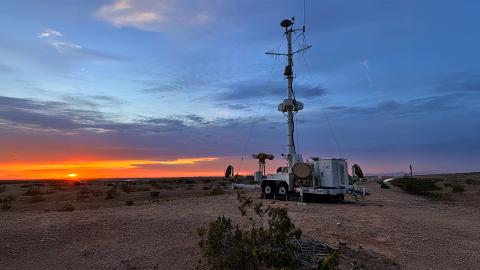
AVT’s strength is the expeditionary, vehicle-mounted case: X-MADIS packages detection and defeat into a system that can be driven to a site and run without a fixed installation. Now inside CACI, it gives buyers a route into a larger defense integrator, with AVT’s optics feeding CACI’s CORIAN and SkyTracker RF layers.
09
Ascent Vision Technologies (CACI)
TIER 1 · MOBILE C-UAS
X-MADIS and CORIAN expeditionary counter-UAS
| 🏭 Industry | Defense and Space Manufacturing |
|---|---|
| 📍 Location | Belgrade, Montana |
| 👥 Size | 51-200 employees |
| 🌐 Website | caci.com |
Ascent Vision Technologies builds gyro-stabilised imaging systems and the X-MADIS expeditionary mobile air-defence system. CACI acquired the company in August 2020 and now pairs its EO/IR and X-MADIS hardware with CACI’s own SkyTracker counter-UAS suite, which includes the CORIAN RF detection and mitigation line.
WhiteFox has been selling counter-drone equipment longer than most of the current US field has existed. DroneFox covers the fixed-site RF detection and mitigation role, while Scorpion 3 gives a dismounted operator a handheld option — a pairing that suits prisons, airports and forward operating bases alike.

10
WhiteFox Defense Technologies
TIER 1 · RF DETECT & MITIGATE
DroneFox RF detection and Scorpion 3 man-portable mitigation
| 🏭 Industry | Defense and Space Manufacturing |
|---|---|
| 📍 Location | San Luis Obispo, California |
| 👥 Size | 51-200 employees |
| 🌐 Website | whitefoxdefense.com |
WhiteFox Defense Technologies was founded in San Luis Obispo, California, in 2016 and was among the first US companies to focus exclusively on counter-drone systems. Its products include DroneFox for RF detection and mitigation and the Scorpion 3 man-portable device.
Dedrone’s advantage is the software wrapper: it turns a mixed sensor estate into one airspace picture that a security team can actually operate. The Axon acquisition ties that picture into the broader law-enforcement technology stack, which matters for police and corrections buyers who already run Axon systems.
11
Dedrone (Axon)
TIER 1 · AIRSPACE SECURITY
Multi-sensor airspace security, now part of Axon
| 🏭 Industry | Security Technology |
|---|---|
| 📍 Location | Sterling, Virginia |
| 👥 Size | 51-200 employees |
| 🌐 Website | dedrone.com |
Dedrone builds counter-drone detection and airspace-security systems for airports, prisons, utilities, stadiums and government sites. Its platform fuses RF, radar, electro-optical and acoustic sensors, and the company completed its acquisition by Axon in 2024.
ApolloShield sells a complete RF-based detect-and-block package rather than components, which makes it attractive to buyers without an integration team. Its focus on prisons and protected sites shows in the operating model: identify the drone, identify the pilot, and hand the evidence to the security staff.
12
ApolloShield
TIER 1 · RF DETECT & MITIGATE
RF detect-and-mitigate for prisons, airports and VIP sites
| 🏭 Industry | Security Systems |
|---|---|
| 📍 Location | Palo Alto, California |
| 👥 Size | 11-50 employees |
| 🌐 Website | apolloshield.com |
ApolloShield builds detection and mitigation systems against unauthorised drones, with a product line aimed at correctional facilities, airports, critical infrastructure and VIP protection. The company is US-registered with a founding team drawn from Israeli defense experience.
UNIFY.C2 is the layer that decides whether a mixed sensor estate behaves like one system. Because it is sensor-agnostic, it lets a site keep existing radars and add new effectors without replacing the whole stack — the integration problem that sinks more counter-drone projects than any sensor shortfall.
13
UNIFY.C2 (SPS ARS)
TIER 1 · COMMAND & CONTROL
Sensor-agnostic counter-UAS command and control
| 🏭 Industry | Defense Software |
|---|---|
| 📍 Location | McKinney, Texas |
| 👥 Size | 11-50 employees |
| 🌐 Website | unifyc2.com |
UNIFY.C2 is a counter-UAS command-and-control platform built by SPS ARS. It fuses radar, RF, electro-optical and infrared sensors with effectors into a single operating picture and is designed to work with both military-grade and commercial off-the-shelf equipment.
Edda attacks the cost problem directly: a cheap, reloadable turret for the last hundred metres rather than a missile for every quadcopter. It is designed for the FPV threat that jamming cannot stop, and its small footprint makes it one of the few US point-defence systems a forward unit can actually carry.

14
9 Mothers
TIER 2 · POINT DEFENCE
Edda autonomous turret built for the FPV drone era
| 🏭 Industry | Defense and Space Manufacturing |
|---|---|
| 📍 Location | Austin, Texas |
| 👥 Size | 11-50 employees |
| 🌐 Website | 9mothers.com |
9 Mothers builds AI-driven counter-UAS point-defence systems in Austin, Texas. Its first product, Edda, is a compact autonomous turret that combines acoustic detection with computer vision to engage small drones at close range.
Spotter’s pitch is volume and price: military-grade radar built as a commercial off-the-shelf product. For a utility substation or a prison perimeter that cannot justify a bespoke radar programme, a Spotter unit plus a C2 layer is often the fastest route to drone awareness.

15
Spotter Global
TIER 2 · COMPACT RADAR
Military-grade COTS radars for drone detection
| 🏭 Industry | Radar Systems |
|---|---|
| 📍 Location | Orem, Utah |
| 👥 Size | 51-200 employees |
| 🌐 Website | spotterglobal.com |
Spotter Global manufactures compact surveillance radars for perimeter and critical-infrastructure protection, including holographic 3D radar and drone-detection models. The company reports more than 10,000 COTS radars sold and manufactures in the United States.
DeTect came to counter-drone from bird-strike avoidance, which is why its radars are unusually good at separating small, slow targets from clutter. That heritage matters at airports, where the same sensor has to see a drone without alarming on every flock of geese.
16
DeTect, Inc.
TIER 2 · RADAR & RF
HARRIER radar and DroneWatcher detection
| 🏭 Industry | Radar and Remote Sensing |
|---|---|
| 📍 Location | Panama City, Florida |
| 👥 Size | 51-200 employees |
| 🌐 Website | detect-inc.com |
DeTect specialises in applied radar remote sensing for aviation safety, security and environmental monitoring, with more than 1,000 systems delivered. Its counter-drone offer combines the HARRIER radar family with DroneWatcher detection products.
O.W.L.’s radars were built for ground surveillance first, which gives them a useful property in counter-drone work: they track a drone and the person launching it in the same picture. For a site that needs to catch the operator as well as the aircraft, that is a meaningful difference.
17
Observation Without Limits (O.W.L.)
TIER 2 · GROUND SURVEILLANCE RADAR
GroundAware 2D and 3D radars for drone awareness
| 🏭 Industry | Radar Systems |
|---|---|
| 📍 Location | Huntsville, Alabama |
| 👥 Size | 11-50 employees |
| 🌐 Website | owlknows.com |
Observation Without Limits manufactures the GroundAware family of 2D and 3D digital radars for perimeter intrusion detection, ground surveillance and drone awareness. The company is based in Huntsville, Alabama, and sells to utilities, critical infrastructure and defense customers.
AirSight’s focus is the operational picture rather than the sensor: detect the drone, locate the pilot, and give security staff a response they can act on. That makes it a practical fit for venues and airports where the goal is evidence and intervention rather than kinetic defeat.
18
AirSight
TIER 2 · DRONE & PILOT DETECTION
AirGuard software for drone and pilot detection
| 🏭 Industry | Airspace Security |
|---|---|
| 📍 Location | United States |
| 👥 Size | 51-200 employees |
| 🌐 Website | airsight.com |
AirSight provides drone detection and airspace-security systems for airports, stadiums, critical infrastructure, correctional facilities and law enforcement. Its portfolio includes the AirGuard software platform and the AirSight X detection product.
Picket occupies the 40-metre bubble that other systems ignore. Its turret is meant to sit directly over the asset being protected and handle drones that have already survived the outer layers — an unglamorous role that becomes essential once FPV drones start arriving in numbers.

19
Picket Defense Systems
TIER 2 · CLOSE-IN EFFECTOR
Rotating turret for the last layer of defence
| 🏭 Industry | Defense and Space Manufacturing |
|---|---|
| 📍 Location | United States |
| 👥 Size | 2-10 employees |
| 🌐 Website | picketdefense.com |
Picket Defense Systems builds close-in counter-UAS systems built around a patented rotating turret. The company describes its product as the last layer of defence, designed to neutralise hostile drones at very short range with 360-degree coverage.
Drone Defense Systems is a systems integrator in the practical sense: it packages detection and mitigation into a deployable site solution rather than selling a single box. That suits public-safety and municipal buyers who need a working installation and a support contract, not a research project.

20
Drone Defense Systems LLC
TIER 2 · INTEGRATED SYSTEMS
Integrated detection and mitigation for fixed sites
| 🏭 Industry | Public Safety Technology |
|---|---|
| 📍 Location | Daytona Beach, Florida |
| 👥 Size | 11-50 employees |
| 🌐 Website | dronedefense.systems |
Drone Defense Systems provides integrated drone detection and mitigation systems and services to government, critical-infrastructure and public-safety customers. Its proprietary anti-drone system automatically detects and responds to unauthorised drone activity.
Talon is a small team attacking the same problem as the primes: how to defeat a cheap drone without spending a missile. SECTR’s software-defined approach means the engagement logic can change with the threat, which is the advantage a small company has over a large one with a fixed product line.
21
Talon Avionics
TIER 2 · KINETIC DEFEAT
SECTR software-defined mobile counter-UAS
| 🏭 Industry | Defense and Space Manufacturing |
|---|---|
| 📍 Location | United States |
| 👥 Size | 2-10 employees |
| 🌐 Website | talonavionics.com |
Talon Avionics builds software-defined, mobile counter-UAS systems. Its SECTR platform is designed to neutralise low-cost drones using kinetic, non-explosive methods with low collateral risk.
ZeroMark’s premise is that the infantry already has the effector — it just cannot hit a moving drone. Adding an AI targeting layer to existing rifles is far cheaper than fielding a new weapon, and it addresses the FPV threat at the exact point where it becomes lethal.
22
ZeroMark
TIER 2 · AI FIRE CONTROL
AI targeting layer that turns rifles into drone defence
| 🏭 Industry | Defense Technology |
|---|---|
| 📍 Location | New York, New York |
| 👥 Size | 2-10 employees |
| 🌐 Website | zeromark.com |
ZeroMark develops an AI-enabled targeting layer for defense applications. Its counter-drone product adapts commercial firearms with computer vision and auto-aiming to help a soldier engage small drones.
Valkyrie treats counter-UAS as an air-to-air problem: put a crewed or uncrewed aircraft up to intercept the intruder before it reaches the target. That is an expensive answer to a cheap drone, but it is also the only option for wide-area defence where ground sensors cannot cover the approach.
23
Valkyrie Aero
TIER 2 · AIR-TO-AIR C-UAS
Manned and unmanned aircraft for counter-drone defence
| 🏭 Industry | Defense and Space Manufacturing |
|---|---|
| 📍 Location | Mesa, Arizona |
| 👥 Size | 11-50 employees |
| 🌐 Website | valkyrieaero.com |
Valkyrie Aero is a US defense contractor and tactical technology company. It delivers counter-UAS aircraft, pilot and joint terminal attack controller training programmes, and air-to-air defence solutions built by operators with combat experience.
Solakair is betting that the interceptor should be a drone, not a missile. A reusable VTOL platform can patrol, identify and engage without expending itself on every sortie, which changes the economics of defending a large area against repeated incursions.
24
Solakair
TIER 2 · INTERCEPTOR
Solace reusable VTOL air-superiority drone
| 🏭 Industry | Aviation and Aerospace |
|---|---|
| 📍 Location | Fremont, California |
| 👥 Size | 2-10 employees |
| 🌐 Website | solakair.com |
Solakair builds Solace, a reusable vertical take-off and landing drone designed for air-superiority missions: detection, identification, targeting and precision engagement of hostile drones in contested environments.
Parallax is selling arithmetic as much as hardware: a $500 drone should not require a $2 million interceptor to stop. Its low-kinetic effector is designed to be cheap enough to fire repeatedly and safe enough to use where fragments would be unacceptable.
25
Parallax Defense
TIER 2 · LOW-KINETIC EFFECTOR
Autonomous detect-to-defeat with a non-fragmenting effector
| 🏭 Industry | Defense and Space Manufacturing |
|---|---|
| 📍 Location | Berkeley, California |
| 👥 Size | 2-10 employees |
| 🌐 Website | parallaxdefense.us |
Parallax Defense builds fully autonomous counter-UAS systems around a low-kinetic, non-fragmenting effector. The company claims a cost per engagement orders of magnitude below interceptor missiles, with an effectively unlimited magazine.
Ravenstrike is early-stage and tiny, but it represents a real pattern in the US market: veterans building a specific counter-drone tool rather than a platform. Its kinetic-plus-EW framing acknowledges that jamming alone fails against autonomous drones, and that a physical effector still has to finish the job.
26
Ravenstrike Defense
TIER 2 · KINETIC + EW
Operator-forged kinetic counter-UAS with integrated EW
| 🏭 Industry | Defense and Space Manufacturing |
|---|---|
| 📍 Location | Commerce Township, Michigan |
| 👥 Size | 0-1 employees |
| 🌐 Website | ravenstrikedefense.com |
Ravenstrike Defense is an operator-founded company developing kinetic counter-UAS technology with integrated electronic warfare. Its stated focus is kinetic dominance of the airspace over a protected element.
Drone Round takes the least glamorous route to counter-drone defence: improve the ammunition. It requires no new launcher, no spectrum allocation and no integration project, which makes it attractive to police and military units that already carry firearms and need a better answer for a quadcopter overhead.
27
Drone Round
TIER 2 · AMMUNITION
Anti-drone rounds built on Freedom Munitions manufacturing
| 🏭 Industry | Defense Manufacturing |
|---|---|
| 📍 Location | United States |
| 👥 Size | 51-200 employees |
| 🌐 Website | dronerounddefense.com |
Drone Round develops counter-UAS ammunition and technology, backed by the manufacturing capacity of Freedom Munitions and Unlimited Ammo. The company’s products are conventional rounds adapted to engage small aerial targets.
Atrelon addresses the failure mode that most C2 vendors ignore: what happens when the network is jammed. Its decision-support layer is built to keep a counter-drone operation running under electronic attack, which is precisely the condition a peer conflict would create.
28
ATRELON
TIER 2 · C-UAS SOFTWARE
Cognitive C-UAS decision support under EW and signal denial
| 🏭 Industry | Defense Software |
|---|---|
| 📍 Location | Arlington, Virginia |
| 👥 Size | 2-10 employees |
| 🌐 Website | atrelon.com |
Atrelon builds cognitive counter-UAS operations software for defense ministries and critical-infrastructure operators. Its platform is designed to support operator decisions when communications are degraded by electronic warfare or signal denial.
NQDEFENSE sells the full fixed-site package — detection, jamming and ancillary security sensors — at a price point that fits police and corrections budgets. Buyers should note the group’s international manufacturing base when assessing supply-chain and compliance requirements.
29
NQDEFENSE (NovoQuad)
TIER 2 · DETECTION & JAMMING
Integrated anti-drone systems and RF jamming
| 🏭 Industry | Defense and Security Systems |
|---|---|
| 📍 Location | Wilmington, Delaware |
| 👥 Size | 51-200 employees |
| 🌐 Website | nqdefense.com |
NQDEFENSE is the US arm of the NovoQuad Group, which builds anti-drone and security systems. Its product line includes integrated anti-drone stations, RF jammers, through-wall radar and Wi-Fi interception equipment.
Zaruba’s passive detector listens for the drone and its video link without emitting, which keeps the operator hidden and works against drones whose control link is hard to jam. The net launcher gives a physical capture option for the last few metres, where RF defeat is not allowed.

30
Zaruba Tech
TIER 2 · PASSIVE RF
Passive RF drone detectors and net launchers
| 🏭 Industry | Defense Electronics |
|---|---|
| 📍 Location | United States |
| 👥 Size | 201-500 employees |
| 🌐 Website | zaruba.tech |
Zaruba Tech is a US-based manufacturer of defense radioelectronics and unmanned systems. Its counter-drone products include passive RF and FPV-video detectors and a net launcher, alongside FPV strike drones, UAVs and ground robots.
Moodro’s pilot-localisation capability is the feature that matters for border and critical-site work: stopping the drone is temporary, finding the operator is not. Its passive approach also avoids the spectrum-licensing problem that limits active jammers in civil settings.
31
Moodro Inc.
TIER 2 · PASSIVE RF
Passive RF detection with enemy pilot localisation
| 🏭 Industry | Defense and Space Manufacturing |
|---|---|
| 📍 Location | United States |
| 👥 Size | 2-10 employees |
| 🌐 Website | moodro.net |
Moodro builds a passive-RF counter-UAS ecosystem that detects drone emissions, identifies the threat autonomously and localises the pilot. The company was founded to support Ukraine and allied forces against low-cost drones.
Lighthouse targets the middle ground between a full radar and a pair of binoculars: a passive sensor that tells a site something is in the air and where it is, without emitting. Its dual-use design also serves drone operators who need to see other traffic, which widens the addressable market.
32
Lighthouse Avionics
TIER 2 · PASSIVE SENSING
VICTOR passive air-domain awareness
| 🏭 Industry | Aviation and Aerospace |
|---|---|
| 📍 Location | Hilliard, Ohio |
| 👥 Size | 11-50 employees |
| 🌐 Website | lighthouseavionics.com |
Lighthouse Avionics builds passive, ground-based air-domain awareness systems for counter-UAS detection and beyond-visual-line-of-sight drone operations. Its VICTOR product combines electro-optical and infrared cameras, ADS-B and laser rangefinding.
Kytyra sells the part of the kill chain that is hardest to get right: deciding what the object is. Classification is where false alarms and missed detections are created, and a low-SWaP sensor aimed at mobile platforms addresses a gap that fixed radar installations cannot fill.
33
Kytyra
TIER 2 · DETECTION SENSOR
Low-latency drone recognition and classification
| 🏭 Industry | Defense Sensors |
|---|---|
| 📍 Location | Round Rock, Texas |
| 👥 Size | 2-10 employees |
| 🌐 Website | kytyra.com |
Kytyra engineers low-latency sensors for counter-UAS systems, focused on drone recognition and classification. The company positions its hardware as the detection layer that overcomes the environmental limits of existing sensors in mobile, low-SWaP applications.
Rodor’s premise is that the drones that matter now often emit no radio signal, so a detection layer built only on RF misses them. Echo1 focuses on giving event security a usable live picture and a post-event record — the evidence trail that a police hand-off depends on.
34
Rodor Security
TIER 2 · NON-RF DETECTION
Echo1 drone detection for events and protected sites
| 🏭 Industry | Security Technology |
|---|---|
| 📍 Location | United States |
| 👥 Size | 2-10 employees |
| 🌐 Website | rodorsecurity.com |
Rodor builds drone-detection systems for event security and protected sites. Its Echo1 product gives security teams a live map of detected drone activity and a flight record to review afterwards.
PerceptView supplies the confirmation layer: once radar or RF says something is there, an EO/IR system has to identify it and keep it in frame. That identification step is what separates a detection alert from a decision to act, and it is the piece most often bought last.
35
PerceptView
TIER 3 · EO/IR TRACKING
Long-range electro-optical tracking for C-UAS
| 🏭 Industry | Defense and Space Manufacturing |
|---|---|
| 📍 Location | Garden City, Idaho |
| 👥 Size | 2-10 employees |
| 🌐 Website | perceptview.com |
PerceptView develops electro-optical and infrared camera and tracking systems for long-range surveillance and counter-UAS applications. Its systems are used in military, critical-infrastructure and commercial settings.
RP Optical is a component supplier rather than a system vendor, but its IR optics sit inside many counter-drone cameras. Buyers specifying an EO/IR detection layer should know who makes the lens, because thermal performance at range is decided there, not in the software.
36
RP Optical USA
TIER 3 · IR OPTICS
SWIR, MWIR and LWIR optics for counter-drone sensors
| 🏭 Industry | Electro-Optical Systems |
|---|---|
| 📍 Location | Tavares, Florida |
| 👥 Size | 2-10 employees |
| 🌐 Website | rp-optical-usa.com |
RP Optical USA supplies thermal and electro-optical lenses, cameras, cores and custom imaging systems. The company offers a large library of optical designs and builds custom infrared solutions for defense and security customers.
BlackByrne’s contribution is the human gate: a system that fuses the threat picture but keeps a person in the decision loop, with an auditable record of what was seen and why. That is increasingly what civil and allied buyers need before any effector is authorised.
37
BlackByrne (Dark Vector Technologies)
TIER 3 · DECISION SUPPORT
DaggerOS multi-domain decision support
| 🏭 Industry | Defense Software |
|---|---|
| 📍 Location | United States |
| 👥 Size | 11-50 employees |
| 🌐 Website | darkvectortechnologies.com |
BlackByrne, which trades on the former Dark Vector Technologies domain, develops DaggerOS — an air-gapped, evidence-first decision-support operating system spanning counter-UAS, electronic warfare and adjacent domains. The company is veteran-founded.
Start with the threat model, not the catalogue. A fixed critical-infrastructure site that needs early warning should shortlist radar and RF detection first — Echodyne, SRC, Spotter Global, DeTect and Observation Without Limits all sell sensors that can be integrated by a third party — then add a C2 layer such as UNIFY.C2 or Fortem’s SkyDome only once the sensor mix is settled. A site facing FPV or fibre-optic drones that emit no radio signal needs a different stack: acoustic, electro-optical or radar detection plus a kinetic effector, which is where 9 Mothers, Picket, Parallax, Solakair and Drone Round compete. Buyers who want one contract and one throat to choke should stay with RTX, AeroVironment, L3Harris or Anduril; buyers who want to integrate sensors they already own should look at the specialist tier. Whatever the requirement, the legal constraint binds first: US law treats a drone as an aircraft, and destroying one is a federal felony carrying up to 20 years’ imprisonment under 18 U.S.C. § 32, while radio interference is restricted under 47 U.S.C. § 333. Active mitigation has historically been reserved to designated federal agencies; commercial operators should plan for detection and hand-off, and confirm current authority with counsel before buying an effector. Buyers comparing other markets should read our UK counter-drone companies and Indian counter-drone companies lists; the shortlist logic is the same, the suppliers are not.
MarketsandMarkets forecasts the US counter-UAS systems market at $2.49 billion in 2025, growing to $8.60 billion by 2030 at a 28.1% CAGR, above the 25.1% global rate. Definitions vary widely: some reports count only detection hardware, others include C2 software, effectors and services, so figures can differ by a factor of two or more. Buyers should check what a number includes before using it to size a budget.
The prime tier is RTX (Coyote interceptors and KuRFS radar), AeroVironment (Titan, LOCUST and the SkyView RF line), L3Harris (VAMPIRE) and Anduril (Roadrunner and Lattice). Below them sit full-stack specialists such as Ondas Sentinel, Fortem Technologies, Ascent Vision Technologies (CACI), WhiteFox Defense, Dedrone (Axon) and ApolloShield, plus sensor houses including Echodyne, SRC, Spotter Global, DeTect and Observation Without Limits.
Not as a general rule. A drone is an aircraft in US law, and destroying or disabling one is a federal offence under 18 U.S.C. § 32, punishable by up to 20 years’ imprisonment. Wilful radio interference is separately restricted under 47 U.S.C. § 333, and the FAA states plainly that shooting at any aircraft is illegal. Active mitigation has historically been limited to designated federal agencies; private operators can detect, track and report, and should confirm current authority with counsel before deploying any effector.
Four layers dominate: radar for range and tracking, RF for detecting the control link and often the pilot, electro-optical and infrared for classification, and acoustic sensing for close-in detection of low, quiet drones. Most US systems fuse at least two. Radar selection is covered in our drone detection radar guide, RF detection in Counter UAS RF, and the terminology in the C-UAS glossary.
Primes win on integration, sustainment, security clearance and programme-of-record experience, and they are the safer choice for a multi-site federal or defence requirement. Specialists win on sensor performance, price and speed, and they are usually the better fit for a single site that already has detection and needs one more layer. The practical pattern in the US market is a specialist sensor fused into a prime or third-party C2 platform — which is why the C2 layer, not the sensor, often decides whether a system works.


